

A personal gift doesn't have to be expensive or flashy to have real value for the recipient. Gifts that remind us of a shared experience, an important moment or a person we care about are often the most impressive. Photographs are a natural choice for such a purpose – they capture memories that are especially important to a specific person.
Many different gifts can be made from your own pictures: from one photo in a frame to a photo book or calendar to a set of printed photos or photo magnets. Each of these options is suitable for a different occasion and a different way of use. Therefore, when choosing, it is not only the appearance of the final product that matters, but also who it is intended for and what memory it is supposed to evoke.
In this article, we will look at the different forms of photographic gifts, advise on the selection of suitable images and show what to think about before printing them. The goal is not to find one universally best gift, but a solution that will match the recipient, the occasion and the story captured in the photos.
The value of a photograph lies not only in what is captured in it. The story that the recipient associates with her is also important. A photo from a vacation can remind you of a joint adventure, a family photo of a certain period of life, and a discreet snapshot of a situation that would otherwise be forgotten over time.
It is the personal connection that distinguishes a photographic gift from an ordinary item bought in a store. It shows that the donor took the time to select specific memories and thought about what they mean to the recipient. The resulting gift does not have to be surprising due to its price or size - its main value is the attention put into its preparation.
Another advantage of photos is their versatility. They can form one distinct image, chronologically tell a longer story or remind several separate moments. Depending on the chosen design, they can be displayed in a visible place, stored in a photo album or used as part of a practical object. A photographic gift can therefore be adapted not only to a specific occasion, but also to the nature and habits of the person for whom it is intended.
When preparing a photographic gift, the most difficult part is the selection of images itself. There can be hundreds to thousands of photos on your phone or computer, and it's easy to feel that it's necessary to select only the most technically perfect ones. However, for a personal gift, the meaning of the captured moment is usually more important than the flawless composition.
As a rule, the most suitable are photographs with which the recipient has a personal relationship. They can depict a joint holiday, a family celebration, a wedding, a trip or an ordinary day that the recipient of the gift likes to remember. A good tool is to ask yourself what kind of memory the photo is supposed to evoke, not just whether everyone looks perfect in it.
If you are selecting multiple images, try to make them form a whole together. They can follow the development of a relationship, commemorate one significant period or combine events from several years. A set of photos need not be arranged chronologically, but should have a clear common idea.
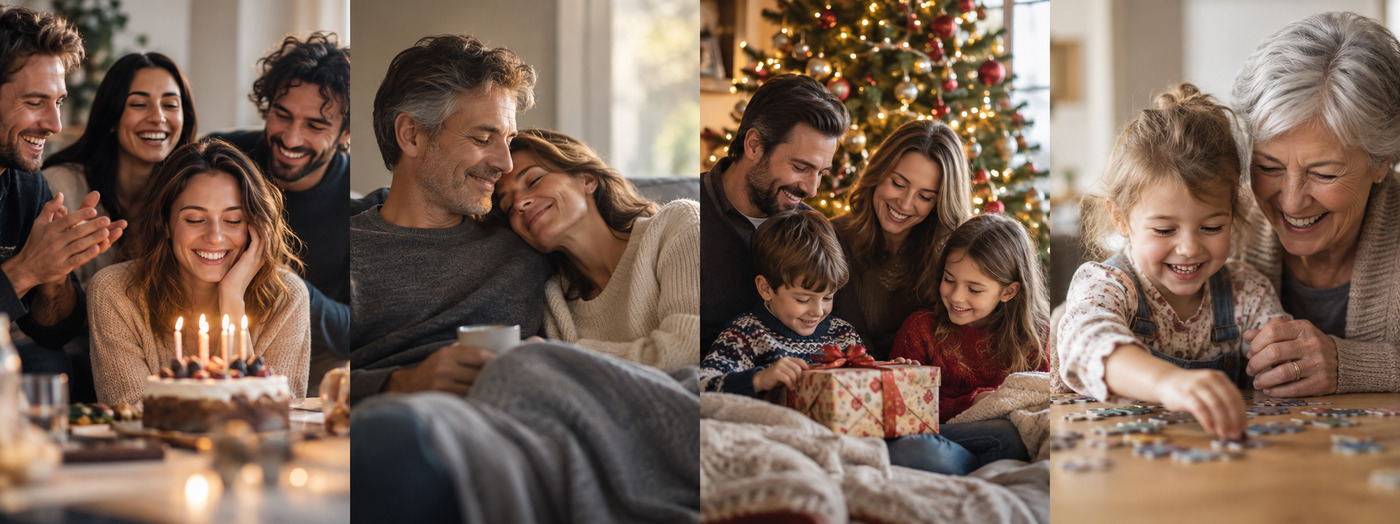
Arranged portraits can look beautiful, but often it is the unobtrusive snapshots that capture the atmosphere of the event most faithfully. Laughter at a shared table, a child focused on a game or a view from a trip can have more value to the recipient than a formal photo taken in front of a prepared background.
Therefore, a minor technical imperfection may not be a reason to discard a picture. Slightly worse light or a less accurate composition may not be a problem if the photo captures a unique moment. However, it is important that it is not significantly blurred, too dark or of such poor quality that its shortcomings become even more prominent after printing.
A collection consisting only of similar portraits can appear monotonous. You can achieve a more interesting result by combining details, joint photos, wider shots of the environment and small moments that complete the whole story. For example, you can add a place you've visited, a favorite object, or another motif associated with a shared experience to people's photos.
However, variety should not mean randomness. Individual images may have different content, but it should still be obvious why they belong to the same gift. A connecting element can be a specific person, journey, family, friendship or a certain period of life.
One exceptionally strong image is best taken on its own in a frame or as a painting. A photobook, on the other hand, offers space for a more extensive story and a larger number of photos. A set of separate prints or photo magnets is useful when you want to combine several memories, but at the same time leave the recipient the option of arranging the photos as they wish.
It is not necessary to use all the images you have available. A carefully selected smaller collection usually feels more personal and thoughtful than a large number of similar photos. If you can't decide between two pictures, choose the one that better describes the moment or the relationship with the recipient.
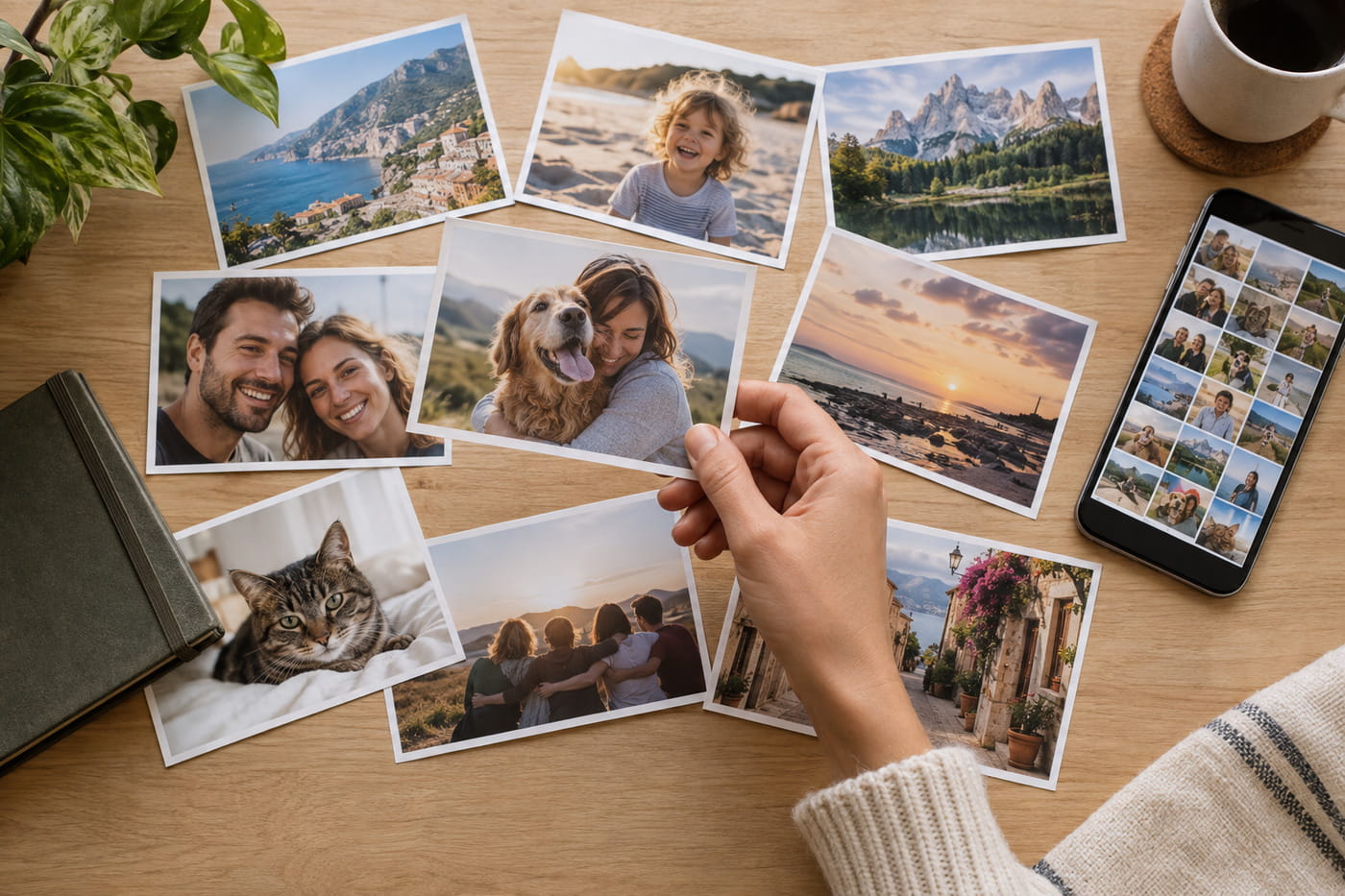
The same photos can make a very different gift depending on the chosen design. Someone will appreciate a comprehensive photobook, someone else prefers to display one striking image, and another will want to change the photos continuously. When making a decision, it is therefore good to think not only about the appearance, but also about where and how the recipient will use the photo.
Printed photos leave a lot of freedom for further use. The recipient can put them in an album, pin them on a bulletin board, display them on a shelf or gradually create their own collage. It is especially useful when you want to gift several different memories without predetermining their final arrangement.
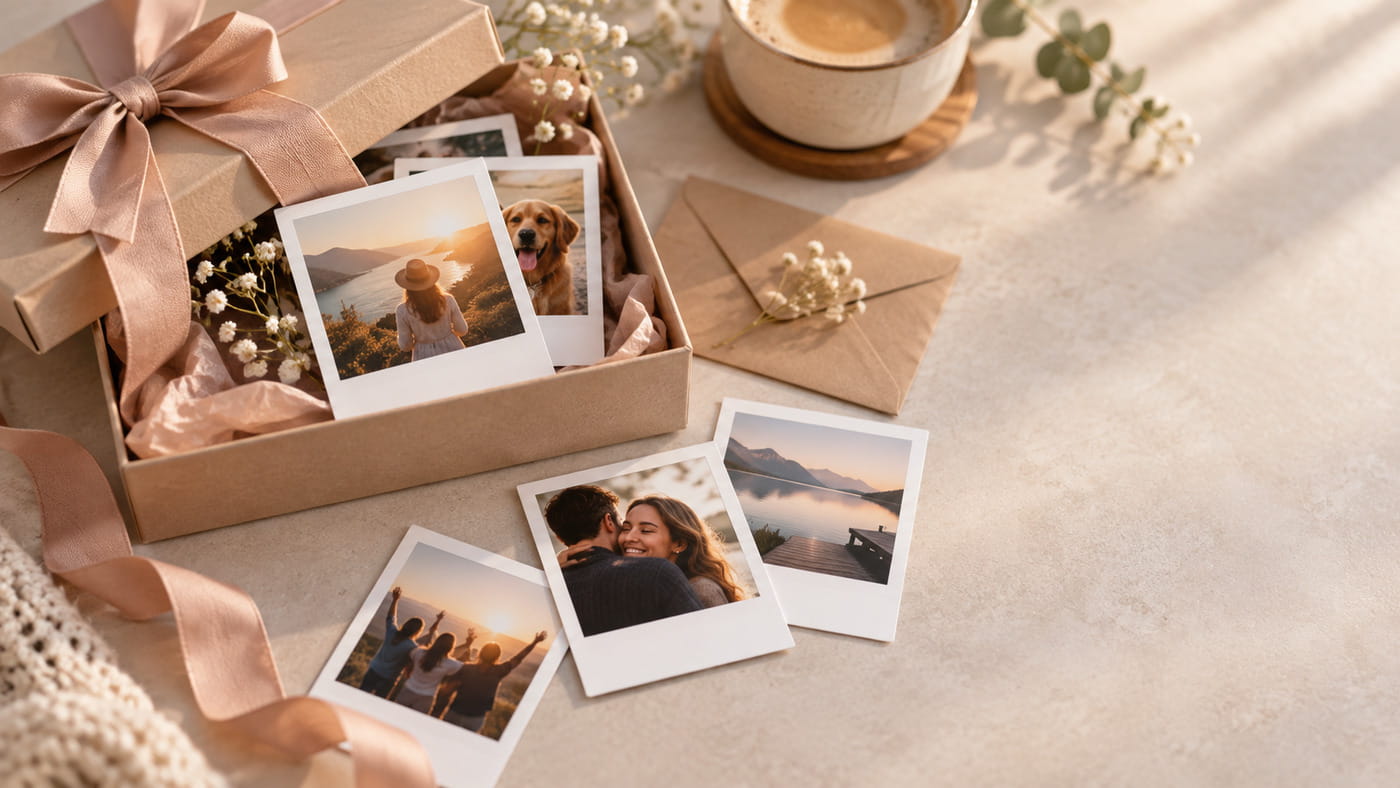
An interesting variant are retro photos with a more prominent frame, reminiscent of classic instant photos. A short text, date, place or a simple graphic element can be added to its lower part, depending on the selected design. Each image can thus work independently and at the same time be part of a larger thematic collection.
Photos with a magnetic back are suitable for a person who wants to have his memories in front of his eyes regularly. They can be placed, for example, on a suitable surface of the refrigerator, a magnetic whiteboard or another metal surface that holds magnets. Their arrangement is not permanent, so it is possible to move, replace and gradually add photos.
However, before choosing this option, it is advisable to check whether the recipient has a usable magnetic surface available. For example, the doors of some built-in refrigerators are covered by a furniture panel, and therefore magnetic photos cannot be used directly on them. In that case, classic photos without a magnetic back may be more practical.
A photo book is suitable for a large number of images that together tell a complete story. It can capture a single journey, the first year of a child, the progress of a wedding or a longer period of family life. The advantage is the ability to combine photos with texts and arrange them in a predetermined order.
However, unlike individual photos, the resulting arrangement is fixed. Therefore, preparing a photo book usually requires more time and more careful selection of images. It works best where there is a clear temporal or thematic connection between individual photos.
The photo calendar combines personal memories with practical use. You can choose a different photo for each month or create a smaller thematic collage. It is often suitable as a gift for parents and grandparents who appreciate family photos in a form used throughout the year.
Its natural limitation is time validity. After the end of the given year, it usually no longer serves its original purpose, even if the recipient can keep the favorite pages. When preparing, it is also necessary to think about a sufficient advance before the beginning of the new year.
If you have one particularly great and significant photo, a single framed photo or painting may be the best option. Such a design gives the photo a prominent place in the interior and does not distract from it with other images.
However, it is a good idea to consider the style of the recipient's home, the available space and the orientation of the photo beforehand. A striking picture can be an impressive gift, but at the same time, it interferes more with the appearance of the interior than smaller photos that the recipient can arrange as they wish.
Your own picture can also be placed on a mug, pillow, case, puzzle or other commonly used object. Such a gift can be playful and practical, especially if the photo matches well with the recipient's personality or interests.
With these products, it is advisable to think about whether the photo will really look natural on the given object. For example, a detailed group shot may not be easy to read on a small or curved surface. Simpler motifs and bolder portraits tend to be more suitable for similar uses.
When choosing a photography gift, there is no single design that is best for everyone. It is not only the quality of the selected images that is decisive, but also the personality of the recipient, the number of photos and the way in which the gift is to be used. A memory intended for display in the living room will take a different form and a different collection that can be continuously viewed, moved or supplemented.
Someone likes distinctive personal decorations and likes to display photos in their surroundings. A picture, a frame or a set of magnetic photos may be suitable for such a person. Another prefers more private memories that he can only view when he wants to. In this case, a photo book, album or set of classic photos stored in a box may serve better.
Also think about whether the recipient likes to change the layout of their space. Individual photos give him more freedom than a rigidly created collage or photo book. On the contrary, a person who appreciates a finished and carefully arranged result may be more happy with a gift with a pre-made composition.
The number of pictures significantly affects the appropriate form of the gift. One or two photos need a strong enough theme and are usually suitable for individual display. A smaller collection can commemorate a few important events, while dozens of images already offer space for telling a longer story.
However, a larger number of photos does not automatically mean a more valuable gift. If the individual images are too similar or do not have a clear relationship to the recipient, the resulting collection can appear disorganized. It is better to choose a smaller number of significant photos than to add more just to make the gift look bigger.
Even before ordering, it is useful to imagine where the recipient will keep or display the photos. A large picture needs enough space on the wall, a standing frame a suitable shelf and photo magnets a metal surface that holds the magnets. A photo book or album is less demanding in this regard, as it can be stored together with books and other personal items.
If you are not sure about the equipment or the style of the recipient's home, a smaller and flexible design is a safer choice. Individual photos can be used by the recipient at their own discretion and are not forced to find a place for one prominent object.
Some photo gifts are already complete at the moment of delivery. A picture, calendar or photo book has a fixed form, which the recipient usually does not change further. Separate photos and photo magnets, on the other hand, allow for custom arrangement and can become the basis of a collection to which other memories can be added later.
The open collection is suitable, for example, for families, couples or friends who regularly travel together and experience new events. On the next occasion, it can be expanded with new photos without the original gift losing its meaning.
| If you want | A suitable option |
|---|---|
| Highlight one exceptional image | A photo in a frame or a picture |
| Tell a longer story using many photos | Photo book or photo album |
| Give a smaller collection that can be arranged as desired | Separate photos or retro photos |
| Keep the memories in front of your eyes regularly | Magnetic photos or wall collage |
| Connect photos with everyday use | A photo calendar or a practical object with a photo |
| Gradually add new memories | Photo magnets, album or free photo collection |
The occasion affects not only the form of the gift, but also the choice of photos themselves. While the couple's shared memories are naturally appropriate for an anniversary, a birthday gift can capture more different areas of the recipient's life. At the same time, a photographic gift does not have to commemorate only important events. Sometimes the pictures of ordinary moments together have the greatest value.
A birthday photo gift can commemorate a specific period or offer a cross-section of a longer part of life. For a close friend, you can choose photos from joint trips, celebrations and everyday meetings. A family gift can combine older images with newer ones to show how people and their relationships have changed over time.
When choosing, it is good to think about how the recipient perceives individual memories. Not every funny photo is suitable for public display, and a picture that seems funny to the giver may be uncomfortable for the recipient. A personal gift should please, not embarrass, the recipient.
An anniversary gift can capture the journey together from the first meetings to the present. Photos don't have to come only from important events. It is the combination of wedding, travel, living together and ordinary moments that often best describes the true story of a relationship.
If you're choosing a smaller collection, you can focus on a few moments that represent important milestones. For a larger set, photos can be organized chronologically or divided by shared experiences. Short labels with a place, date or personal memory can add extra meaning to the whole gift.
A Christmas gift does not have to be thematically limited to photos from previous Christmases. It can summarize the entire past year, recall family events, or combine memories that have accumulated in the phones of individual family members during the year.
When preparing a Christmas photo gift, it is advisable to allow enough time. In addition to the production itself, the collection of images, their selection and possible editing will also take time. If you want to use photos from more than one person, it's worth asking for their submissions before you start creating the resulting collection.
A photographic gift can be intended for the newlyweds, but also for parents, witnesses or other people who participated in the wedding. It does not have to be created only from professional wedding photos. Pictures taken by guests often capture low-key situations and views that the official photographer could not see.
When combining photos from multiple sources, you need to take into account different quality, orientation and color presentation. The resulting collection can appear more unified if the images are united by a similar design, for example, the same format, frame or simple way of labeling.
Photos of the family, children and grandchildren are especially important for parents and grandparents. Joint portraits can be suitable, but also pictures capturing ordinary moments, which will allow them to watch how the children grow and how family life gradually changes.
The chosen form should correspond to how the recipient normally uses the photograph. Some people appreciate a photo book stored in the library, others a calendar, and others prefer to display individual photos in a visible place. For older recipients, it is also advisable to take care of the sufficient size of the main motifs and avoid collages that are too small.
It is not necessary to associate a personal gift only with birthdays, anniversaries or holidays. A small collection of photos can be a thank you, a reminder of a trip together, or simply a way to let the other person know you're thinking of them.
It is gifts without an expected occasion that can seem very natural. It does not have to summarize a long period of life or have a festive performance. Often, a few well-chosen photos are enough, the meaning of which both people immediately recognize.
A photo that looks good on a phone screen may not look exactly the same when printed. Before creating a gift, it is therefore advisable to check the quality of the source files, the intended crop and the overall editing of the images. A few simple steps can significantly affect the final impression.
It is best to work with the original photo directly from your phone or camera. Images downloaded from social networks, sent by some communication applications or repeatedly edited may be reduced and more compressed. They often look sharp enough on the phone screen, but fine details can be lost when printed.
If the photo is from someone else, ask to be sent the original file if possible. A screenshot should be a last resort as it usually contains less visual information than the original photo and may also capture parts of the phone's user interface.
A slightly out-of-focus photo can look fine on a small screen, but when enlarged, its flaws become more apparent. Therefore, before use, view the important parts of the image at a larger scale and check especially the faces. If the eyes and main features are not already recognizable in the digital file, the print cannot fill in the missing details.
The required resolution also depends on the resulting size. An image that is sufficient for a small photograph may not be suitable for a large painting. For older photos or files obtained from the Internet, it is therefore especially important to compare their quality with the intended print format.
The digital image and the resulting printed photo may not have the same aspect ratio. When filling the entire print area, part of the image may therefore be cropped. This is most noticeable in photos where important people or objects are too close to the edge.
Always preview the crop to make sure all essential parts of the image remain in it. Pay special attention to faces, hands, tops of heads, and text that were part of the original image. If the composition does not provide enough space, it may be more appropriate to leave a border around the photo than to stretch it over the entire surface at all costs.
Phones and monitors tend to be backlit and often display photos brighter and more prominently than they will on paper. Dark parts of the image may appear less readable when printed, especially if the display is set to high brightness or using a color-enhanced mode.
Therefore, before sending a photo, check that faces are not in heavy shadows and that important details are still clearly visible. However, it is advisable to handle brightness, contrast and color adjustments with care. Filters that are too strong can alter natural skin tones and suppress details in bright or dark areas.
A date, place or a short personal sentence can add extra meaning to a photo gift. However, longer text is difficult to read on a smaller format and can distract from the image itself. A few words that complement the photo but don't explain everything it captures usually work best.
Sufficient font size and contrast to the background are also important. Fine, light text can disappear in a light photo, and thin type may not be legible when printed. In addition, the text or other important elements should not lie close to the edge of the resulting format.
When preparing a large number of photos, it is easy to overlook a repeated image, an inappropriate crop or an image inserted in the wrong orientation. Therefore, before completing the order, go through the individual previews one by one and check their number, filming and any texts.
It is also worth checking whether the collection as a whole corresponds to the original intention. The last check is not just about looking for technical errors – it can also reveal a photo that doesn't fit thematically among the others or unnecessarily repeats the same moment.
The resulting impression is not only created by the photos themselves, but also by the way they are arranged and presented. Even a simple set of printed photos can make a thoughtful, personal gift if there is a clear connection between the individual photos and their presentation is appropriate for the occasion.
If the photos cover a longer period, you can arrange them chronologically. Such an arrangement is suitable, for example, for the development of a relationship, the first years of a child or memories from a longer trip. The recipient can go through the individual pictures one by one and remember how the captured moments connected to each other.
However, chronological order is not the only option. Photos can be categorized by people, places, seasons or types of shared experiences. With a free collection, it can be enough to put the most important picture on top and let the recipient discover the others gradually.
A few words can explain why you selected the particular photos. It can be a short dedication, a date, the name of a place or a sentence commemorating a shared experience. The text does not have to be included on every image - often one message attached to the entire collection is sufficient.
If you add captions directly to the photos, try to maintain a uniform style. Alternating between many different fonts, colors and graphic elements can distract from the images. A simple and easy-to-read design usually makes the memories stand out better.
Free photos can be placed in a hard envelope, box or smaller album. The packaging should be strong enough to prevent the images from bending, scratching or soiling before delivery. If you are tying photos with ribbon, it should not be so tight that it damages the edges of the photos.
The package may also include a handwritten dedication or short instructions for intended use. With magnetic photos, for example, it can be indicated that the recipient can create their own changing gallery from them. However, it is not necessary to determine the exact arrangement in advance - the opportunity to create it to your liking can be part of the gift.
A smaller photo gift can be given on its own or added to another gift as a personal touch. Individual photos can also be part of a surprise, for example, placed in several places, inserted into a wish or gradually revealed in a prepared order.
However, the method of delivery should not overshadow the content itself. If the photos commemorate sensitive or very personal moments, a quiet handover in private may be more appropriate than opening the gift in front of a larger group of people. As with the selection of images, the nature and comfort of the recipient is the most important here.
A photographic gift does not have to be a closed collection. The album can contain several free pages, the box has space for additional images, and the magnetic photo gallery can be expanded over time. The gift can thus gradually capture new shared experiences and change together with the people to whom it belongs.
This option is especially suitable if you want to follow up on the original gift for other birthdays, anniversaries or after a trip together. New photos are then not a repetition of the same idea, but a natural continuation of an already created collection of memories.
When choosing a photo gift, the most important thing is not its size, price or the number of images used. Much more important is the relationship of the photos to the recipient and the memories they will bring back to him. Therefore, one well-chosen picture can be worth more than a large collection without a clear common idea.
Before you start creating a gift, think about who it is intended for, where it will be stored or displayed, and whether it should capture a single moment or tell a longer story. Then select photos in the highest quality available, check their cropping and choose a design that matches the habits of the recipient.
If you want to create a smaller collection of separate memories, you can use retro photos. Each image can work independently, but at the same time it can be combined with others in a thematic series. Classic photos fit, for example, in an album, box or on a bulletin board, while the magnetic version allows you to create a variable gallery on a suitable metal surface.
Create a personal gift from your own photos that will remind you of shared moments.
Create your own retro photos